Power of Agentic Software: software of your own, for everyone
With AI agents, people no longer have to adapt to computers. Software for every purpose, however niche.

Until now, people had to adapt to computers to get software. AI agents turn that around: I describe what I need in my own words and get a program built for exactly that.
That sounds like a small step. But it changes what software can exist at all.
Meeting in the middle
Programming is very technical. You write down what the computer should do in a special language, such as Python or JavaScript. These languages are a compromise.
The human adapts to the computer: they learn a language without ambiguity, where every comma counts. The computer adapts to the human: a translator turns this readable language into machine language. They meet in the middle.
This meeting point comes at a price. If you want software, you need years of training or someone who has it. And someone has to write every line.
Why software is so bloated
Writing a program is expensive; distributing it costs almost nothing. So it pays to build a program for as many people as possible. The foundation is written once; each extra feature brings in new users.
Everyone knows the result: Excel, Word, a CRM or ERP with thousands of functions. Most people might use ten of them. The rest fill menus, require training and make the program cumbersome.
And if you have a problem no software vendor is interested in, you get nothing at all. That leaves an Excel spreadsheet, a piece of paper or a workaround for the standard software.
What AI agents change
Large language models shift the meeting point. The computer now comes almost all the way to the human: I describe what I want in plain language. An AI agent plans, codes and tests; I check, click through and give feedback.
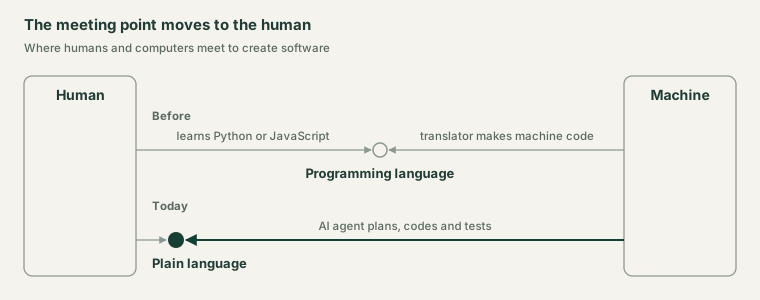
The human–machine meeting point: once in the middle, now on the human side.
This makes software so quick and cheap to build that the old economics are reversed. There is no longer a need for one program for everyone when everyone can have their own. For every purpose, however niche.
Every problem that can be solved with software can now actually be solved. With a program tailored precisely to your own requirements, wishes and expectations. No more, no less.
Two examples
- An Advent calendar that reveals a gift. 19 doors instead of 24, missed days to catch up on, text for children who read for themselves, no tracking. No product on the market does exactly that.
- A tactics board that explains hockey to children like chess. Here too, an AI agent did the coding; I described what I wanted, played and gave feedback.
Neither would ever have been made before: too small for a software vendor, too much work to program yourself.
The catch: software needs maintenance
Every problem being solvable does not mean you build it once and it is finished forever. Operating systems, browsers and interfaces change. Security vulnerabilities appear; data needs to be protected and backed up.
Until now, the software vendor has done this work behind the scenes. If you build your own software, you suddenly realise that it falls to you. And you have to know what you want: the agent builds what you describe, not what you mean.
That is why more people are now coming to understand why software has a monthly cost. A subscription pays for maintenance, updates and security, not the code. This model fits software you build yourself better than a one-off purchase.
There is a solution for part of this: at eigava.de, your own AI assistant builds the app, and eigava takes care of running it, updates and backups, hosted in Germany.