Claude plans, Codex codes: how I use LLMs for programming
Two AI agents in fixed roles, a shared AGENTS.md and the most important rule: build first, ask later.

I now build my projects with two AI agents in fixed roles. Claude is my point of contact: I work out what is to be built with it; it asks follow-up questions and writes the brief. Codex is the implementer and writes the code.
It starts with a project description from me: short, but as complete as I can make it. Claude turns it into a technical spec and already brings questions and uncertainties back to me: what is missing, what contradicts itself, where I need to decide. Codex only starts programming once I have approved the spec.
Then it is Claude’s turn again. It checks what Codex has built and collects the open questions for me. I answer them together, try things out and give feedback. That is how, for example, the tactics board in “Hockey like chess” came about.
Several Claude accounts side by side
I work with several Claude accounts. When one reaches its usage limit, work continues in the next, and projects stay neatly separated.
In Claude Code, an environment variable makes this possible: CLAUDE_CONFIG_DIR points to a separate directory for each account, with its own login, settings and history (guide). Add an alias for each account:
alias claude1='CLAUDE_CONFIG_DIR=~/.claude claude'
alias claude2='CLAUDE_CONFIG_DIR=~/.claude-konto2 claude'
Run claude2 auth login once, and both accounts then run at the same time in two terminals, without logging out and back in. Each directory is a fresh environment, though: you set up skills, MCP servers, hooks and memory for each account or share them via symlinks (example).
One AGENTS.md for both
The ground rules live in an AGENTS.md in the repository. Codex reads it at the start of every session (docs). Claude Code looks for CLAUDE.md, so a symlink points to the same file: ln -s AGENTS.md CLAUDE.md. That gives both agents the same rules.
At its core, it says who does what and how to deal with uncertainty:
# AGENTS.md

## Roles
- Claude is the point of contact: turns my project description into a technical
  spec in docs/spec.md and brings questions and uncertainties to me.
- Codex only starts once I have approved the spec.
- Codex implements: codes the brief with tests, in small steps.
- Claude then checks code and tests against the brief and collects open questions.

## Uncertainty
- Do not stop. Make a plausible assumption, carry on programming with it and
  write the assumption in docs/fragen.md.
- Ask questions together at the end of a step, not one by one along the way.
- Only stop when something cannot be undone: deleting data,
  publishing, spending money.

## Keeping a record
- Decisions belong in docs/spec.md, not just in the chat.
The workflow: plan, build, review, ask
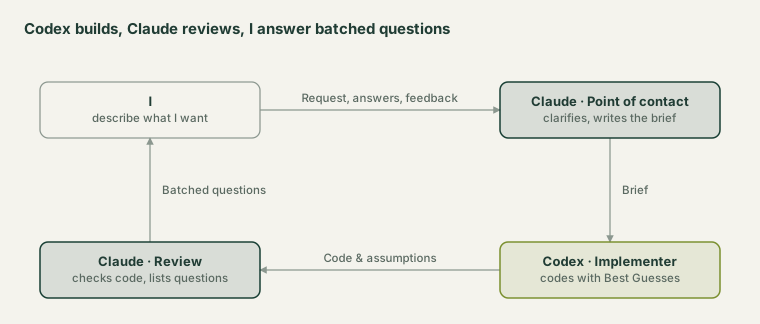
The workflow: four stages, one cycle.
The cycle continues until it is right. Every decision goes into the spec, not just the chat.
Build first, ask later
The most important rule: the agent starts coding with Best Guesses and does not let small details hold it up. A follow-up question can wait until I have time. A wrong assumption can often be corrected in a minute during review.
That is why every assumption goes on a list, and Claude presents them to me together. I decide in one go instead of ten times along the way. I approve what was guessed correctly; the rest becomes a small fix.
Three machines, three tasks
The agents run on three machines, each with its own task.
| Machine | Task | What runs there |
|---|---|---|
| Mac mini (M4 Pro) | Workstation & CI | Claude Code, Codex, CI server |
| Tower | where the programming happens | I can look at the first versions via Tailscale |
| Server | Development server | all the projects run here, essentially my own eigava.de environment |
The idea is that I can access the tower from anywhere using Tailscale, and all the code runs there in its folders. I can either start a Claude instance on the Mac mini and tell it: do this in that repo on the tower, and it takes care of it. Or I go straight to the tower. When Codex has finished coding on the tower, I can look at the result and give feedback. Once it is all right, it goes onto the server. That is where most of the live applications then run, unless they are hosted on Cloudflare Pages.
Looking ahead: several variants instead of one
The goal is to take this rule a step further. When inference is cheap enough, the agent will build several variants for an open question, not just one, and I will choose.
Technically, this is already possible today: each variant is built in its own Git worktree, a separate working folder of the same repository. What is missing is the right price. Three variants cost three times as much computing time.